Sunday, May 19, 2013

Color to the Max

Urban Interiorities by Virginia Melnyk and Tiffany Dahlen
This Japanese nightclub's candyland concept was drawn from Japans colorful youth and fashion culture centered in Harajuku, a neighborhood in the Shibuya ward of Tokyo, Japan. Harajuku is world famous for its colorfully maximalistic street fashion, so building a night club which would cater to these adventurous tastes was definitely a challenge. Designed by Tiffany Dahlen and Virginia Melnyk, American architects and both recent graduates from the University of Pennsylvania School of Design, the building houses a dance club and also contains a restaurant, bar, and several lounges. 


Harajuku street fashion
Melnyk and Dahlen were asked to create a whole "new approach to the night club experience." When asked about the project Melnyk described the inspriation thusly. "It is not by chance that the project looks sweet like Candyland — much of our inspiration came from the sensations of taste and our perception of a visualization of these sensations. It is our hope that this project will push boundaries and leave viewers with a wider imagination of what architecture and design can be.”

The buildings use of color and texture is groundbreaking. Called wacky by many, this nightclub is braver and more visually satisfying that most. Aided by ever advancing computer aided modeling and rendering techniques, the pair generated undulating petal-like surfaces that go beyond just a visual experience and seem to elicit the smells and taste as well. Each flavor of texture fades at its edges like an evaporating scent just before the next colorful texture kicks in and the senses are once again invigorated.

More than just maximalism  this building  embodies another important aspect of Harajuku fashion. With little distinction drawn between what clothes are supposed to be worn by men and which by women this fashion style goes a long way toward the elimination of cultural gender boundaries, similar in effect to the newly cross gender audiences of shows like Adventure Time and the recent anime-like reboot of My Little Pony.  This building does away with distinctions of gender, the distraction of being feminine or masculine, cute or serious, and instead is just visually interesting.  It kills that old fashioned idea that anything made by women or associated with women is niche, by women for women, while products, shows, buildings made by men are universal, for everyone. The building is a feat of form and function, audience and creators all wrapped up in one stunning package. 


- Emily Eifler, Writer, Colour Studio
- Jill Pilaroscia, Principal, Colour Studio


Sunday, May 12, 2013

Paseo Marítimo de la Playa Poniente, Spain


City shorelines tend to be a problem when it comes to the design and maintenance of public spaces. With all that water and sand to contend with theses areas are often left as concrete slabs cut through by periodic access stairs. Take this beach, the one and a half kilometer long promenade originally ran side by side with a four lane thoroughfare and a series of ground-level parking lots. An attempt to improve the strip in the 1970's led to the years of degrading paving and a concrete sea wall which obstructed both views of the beach and physical access. The infrastructure made the beach hard to use, yet another example of public space being ruined by too little consideration.  When the city of Benidorm, in the south of Spain, held a design competition to spruce up the promenade after committing ten million Euros to the project, this eye-catching beauty was the result. 


The city wanted a potent solution to reinvigorate the space, improve the public use of the beach and create a visual relationship between the beach and the juxtaposed office high rises.   Amazingly, thats just what they got. The new promenade uses a rainbow of colors and curves reminiscent of the surf itself to bind the two spaces together. Colors add visual prominence to the walk way when seen from the neighboring sidewalks and store fronts inviting pedestrians  to cross the street and enjoy the view. The diagrams and models shown above illustrate how the serpentine from reflects and thus eases the transition between the urban space and the natural one. 


If you want to know more or see other public spaces that have been similarly improved through  the use of color and architectural intervention visit Public Space, the European Prize for innovation in public space architecture. 


Credits:
DEVELOPER:
Generalitat Valenciana - Ayuntament de Benidorm
AUTHORS:
Office of Architecture in Barcelona
COLLABORATORS:
Luca Cerullo - Dirección de Obra Juan Calvo - Estructura


- Emily Eifler, Writer, Colour Studio
- Jill Pilaroscia, Principal, Colour Studio


Monday, May 6, 2013

Publicolor

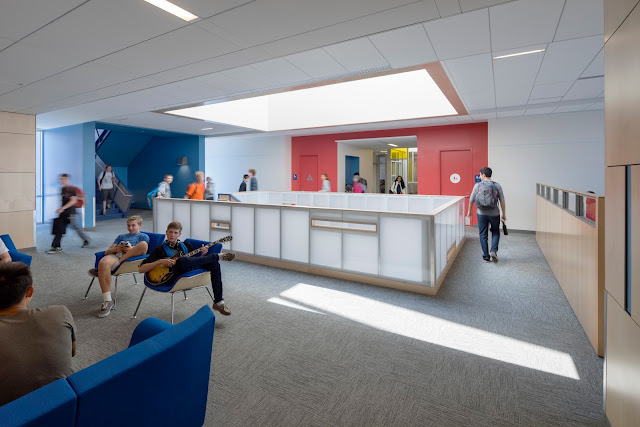
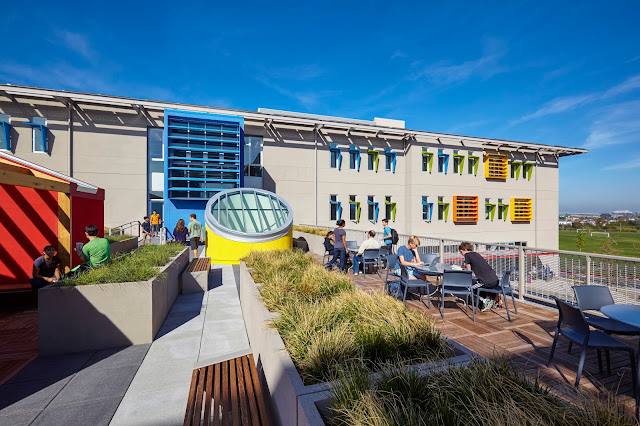
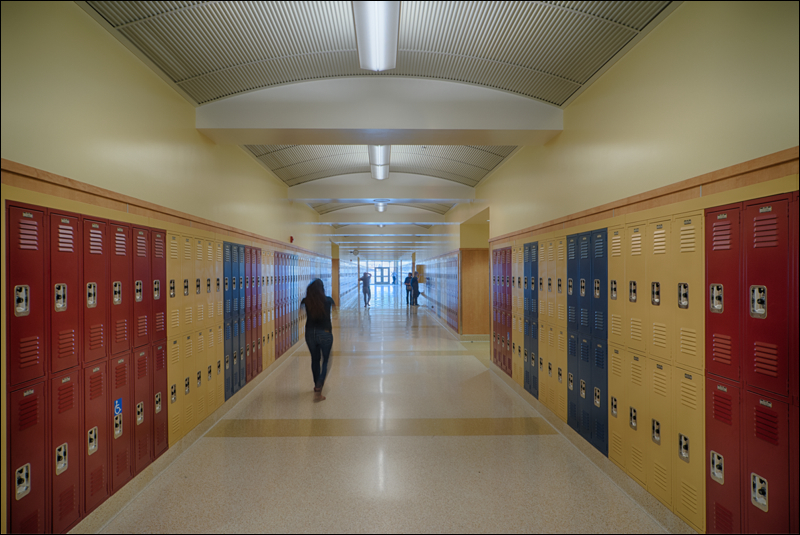
When did the play, color and creativity of kindergarden get bleached from the educational environment?   In primary schools for young children teachers typically decorate their rooms with student art and visuals that relate to the curriculum.    The thought is  lively images  are fun and help children create positive associations with learning. But what about high schools? Some  high school have let the color drain away and schools have become an institutitional shadow of their former selves. Its definitely a problem, and Publicolor is here to help.

The before
Publicolor is a not-for-profit  organization using color and design based programs to help under-performing schools reinvigorate their campuses.   The kids experiencing these enhanced environments increase college and job preparedness. They  believe, and they have the numbers to back this up, that the colorful revitalizations done in collaboration with the students gives students a feeling of ownership of the school. Students involved in these projects are twice as likely as their fellow students to successfully graduate from high school: "94% of Publicolor’s students, 97% of whom are minorities, graduated on time last year. This compared to 58% at their schools."

and after of  Publicolor school painting project
When people like and care about their spaces it not only cuts down on more minor negligences of graffiti and litter, but also gives the students and community members a feeling of civic pride. In this way Publicolor aims to help interrupt the cycle of poverty that plages many of these schools students, their families  and the neighborhoods they live in. 

Publicolor  reminds us of something we all know inherently, the environments we are surrounded by, whether by our own design or by circumstance, change how we think and feel about ourselves, others, and our work.   Environments  can influence how creative, how engaged or rewarded we feel. Color alone cannot give concentration, passion or excitement to the students in these schools, no more than it  can overhaul a poorly operating office or hospital. Color instead is a visual marker of the social reform, acting as a reminder of the communities goals, needs and abilities to come together to create something meaningful. Color encourages and supports us, but ultimately acts as a banner of commitment, past and present, to our places and the people we share them with. 


- Emily Eifler, Writer, Colour Studio
- Jill Pilaroscia, Principal, Colour Studio

Monday, April 29, 2013

Neon and Florescent

via Tumblr
Have you every considered how exactly neon colors work ? What makes them brighter or more visible than normal primary or tertiary colors?

As we all know the whole concept of neon florescent color originated with lighted signs. Neon, like all inert or noble gases have no color, smell or taste, but they do emit certain colors when ionized while trapped in glass tubes.  They were, and sometimes still are, used as an advertising strategy to draw eyes away from competitors painted signs and toward the light up variety. While the signs themselves have diminished in popularity, the colors became widely available and have became part of the cultural vernacular. 


The colors themselves, neon green, electric blue, hot pink, all changed the color landscape for fashion, interior design and even architecture, by redefining and expanding the contemporary palette. But now that these bright colors are no longer restricted to lighted signs what makes them so visually striking?


Amazingly, ultraviolet pigments, previously only associated with flowers and iridescent animals, can now be manufactured and added to paints to give them the glow of lighted signs. Commonly called dayglo colors, what makes them fluoresce is that they absorb light you normally can't see (UV light) and then release that energy as visible light. When in sunlight, or another source of UV light like a blacklight, the colors reflect more light back into your eye. Thus these colors seem brighter and more energetic than everyday colors which can only reflect visible light. The end result is that there is actually more light from those colors interacting with your brain neurons which produce our perception of color.

Today these colors are used for everything from clothing, cars and nail polish to monetary notes, and drivers licenses. It is amazing to think that neon colors push the limits of human visual perception. Before their invention there were few sources of of this visual phenomenon but as our mastery of color through science grows so to do our experiences of the color around us.


- Emily Eifler, Writer, Colour Studio
- Jill Pilaroscia, Principal, Colour Studio

Sunday, April 21, 2013

A Cure for Color Blindness


Could a pair of specialized spectacles be the cure for color blindness? An American research institue based in Idaho called 2AI recently announced exactly that. 

The Oxy-Iso lenses were originally developed to help field medics spot bruising and veins in an injured patient that would have been otherwise difficult to see allowing for better immediate treatment on site. Anyone who has had an IV can attest it's not an experience you want to endure over and over again because the medic could not see the vein clearly. But in a small percentage of test users, those that suffered from red-green color blindness, their red-green vision as well as their ability to see veins was greatly enhanced. 

While this is not a exact cure, just as wearing prescriptions glasses or contacts is not a cure for those of us who are near-sighted, it has the potential of greatly enhancing the color perception of the wearer. The downside to the technology at this point is that the lenses can not be worn while driving as they make yellow nearly invisible. So why use them at all? Why is seeing just a few more colors all that necessary?


Mark A. Changizi (pictured above), the Director of Human Cognition at 2AI, states why red-green color vision is so important to our species. Previous theories thought that our three cone system evolved as follows: yellow-blue for living in a world with mostly green plant life, greyscale for depth and contrast, and red-blue for picking brightly color fruits out of the background. The problem with the rationale comes when you examine the diet of various primates who have the same color vision as we do. Depending on the geographic location and the diet of the species, you see huge variety in the visual requirements for survival. Wouldn't evolution have specialized vision to accommodate the diet of each species over time if that were the case? 

Changizi thinks those primates weren't looking at food but instead looking at each other. He postulates our "color vision was for sensing others of our own primate kind, to sense the ... signals we display on our faces, rumps and genitalia." And the human color vision even "evolved above and beyond that found in other mammals... allowing us to sense colour-signals on the skin, including blushes, blanches, as well as sensing health."

This is an exciting break through for the few women but nearly one out of ten men that suffer from the condition. We want to know what you think. Are you color blind or know someone who is? Would you consider a sometimes fix for your red-green color blindness to perhaps see faces and emotions more clearly? Let us know in the comments.


- Emily Eifler, Writer, Colour Studio
- Jill Pilaroscia, Principal, Colour Studio


Wednesday, April 17, 2013

Getting in the swing of spring!


Though many of our fellow color lovers  to  the north and midwest may still be experiencing snow here in San Francisco spring is springing. So to distract ourselves from the constant sneezing and itchy eyes that allergy season brings and to take our mind of spring cleaning  we have decided to kick off the new season with some decorating ideas.   How you spruce up your home after the long wet winter? Cut flowers? Garlands? Change the artwork around? Here are some of our ideas!


To make your home feel lively and feel fresh try decorative paper  stands featuring spring motifs to add a festive feel for April and May. A lot can be accomplished with a dash of  pattern and color.

If you're a more advanced paper crafter you could  try these  delicate spherical doilies.   Depending on the colors you choose your home could be in for a bold splash or a  pastel breath of spring. 


There are wreaths as well. Though traditionally thought of as a winter holiday classic you can hang one on your door in any season. If you are bathing in the warm California sunshine, you may  be surrounded by over-burdened lemon trees. It seems lemonade can simply not be made as fast as these trees produce so why not use the extras for your  decorating project. No lemon trees around? Collecting newly green branches or wild flowers from your area will give your wreath that added local feel. 


Along with cut flowers there is  the time honored decorating standard of budding branches and the all green floral arrangement to consider.  Adding dramatic sprigs of green can  help envigorate the feeling of a room. You can use anything from a cutting of those thornless vines creeping over you back yard, some textural wild weedlings, or even left overs from your tree pruning project. 


Even if you are still stuck in the snow with little green to harvest you can always make your own colorful leaves! Whether all green or multicolored,  a few dry branches and twigs can bring the springtime inside without all that pesky water. Just cut, glue and arrange!


What are you planning for this years spring spruce?  Let us know in comments and from everyone here at Colour Studio: Have a colorful season!


- Emily Eifler, Writer, Colour Studio
- Jill Pilaroscia, Principal, Colour Studio

Saturday, April 6, 2013

Musée du quai Branly


Just a block from the Eiffel Tower and surrounded by traditional picturesque French architecture sits both a lush and living building.   Its bold mixture of color and shape  causes it to stand out from the crowd. This is the Musée du quai Branly, or Quai Branly Museum in English, which hosts a large and diverse collection of indigenous art and cultural artifacts from Asia,  Africa, Oceania and the Americas. The museum, a relatively recent addition to the international museum scene, was finished in 2006.


Designed by architect  Jean Nouvel, the museum complex contains  exhibition spaces, a large multimedia library, indoor and outdoor gardens along with the obligatory offices and storage space for the rotating collection.


Nouvel worked a subtle but still visible architectural statement into the exterior of the museum.
Instead of presenting one unified face for a museum dedicated to the art of disparate peoples from all over the world, he designed the exterior to signify the coming together of distinct cultures. While the sizes and colors of the various boxes vary the building still presents a collective spacial solidarity. The boxes fracture what might otherwise have been a simple glass wall into something meaningful alluding to the diverse  collection housed within.


Behind the lush textures of the exterior lays a well crafted and intentionally circuitous interior designed with a conscious melding of architecture and color to smooth the transitions for the visitors between exhibits of different time periods and geographic origins.   Nouvel used color (along with hidden lighting, changing ceiling heights, and sweeping ramps) to conceal the 'buildingness' of museum. The dark almost brooding colors of the upper levels fade to creamy tan and warm peach near the exhibition floor adding to the overall effect. Color becomes culturally personal to each exhibition space that not only allows for easier navigation, but helps ground the view to each new space the visitor enters.


But we what to know what you think. Have you visited the Musée du quai Branly? Have other museums you've seen used color to suport the goals of the museum? Let us know in comments!


- Emily Eifler, Writer, Colour Studio
- Jill Pilaroscia, Principal, Colour Studio